
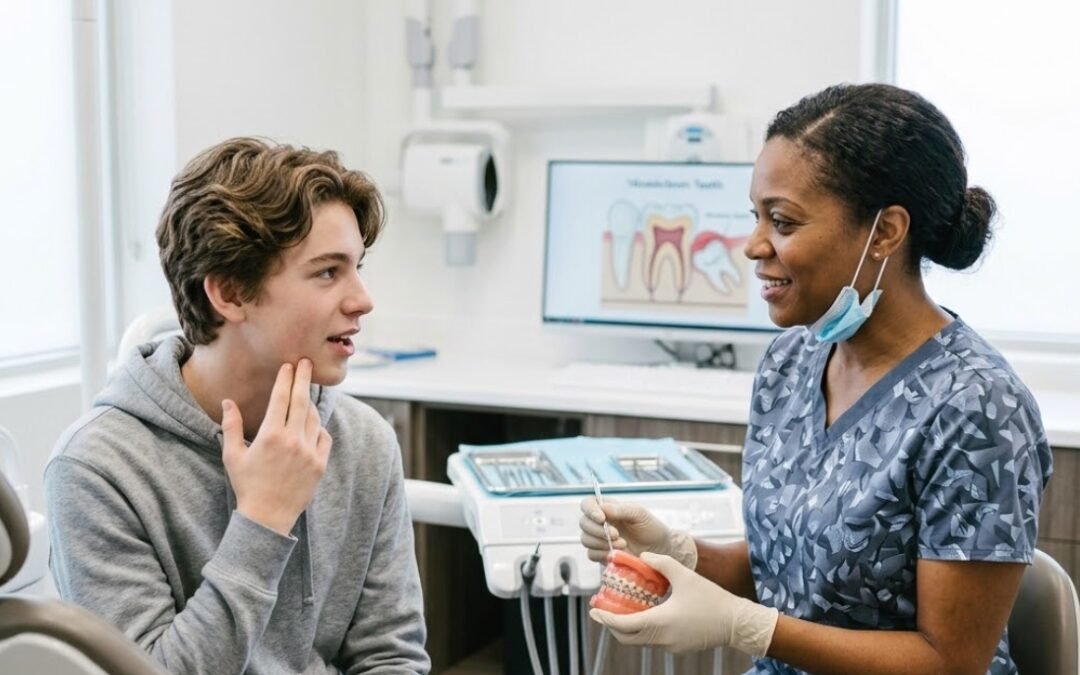
Gingivitis is the first, reversible stage of gum disease, marked by red, swollen or bleeding gums. It develops when plaque bacteria accumulate at the gumline and trigger inflammation. Plaque is a sticky film that forms continuously on teeth, and when it is not removed through brushing and flossing, it irritates the gum tissue. Catching it early matters because, at this stage, gums can usually return to health once plaque is removed. If left untreated, inflammation can extend below the gumline and progress to irreversible periodontitis, where the bone and tissues supporting the teeth are damaged.
Early signs include gums that bleed when brushing or flossing, tenderness, slight swelling and a change in gum colour from healthy pink to red or purple. Some patients also notice bad breath or a bad taste that does not improve with brushing. These symptoms are easy to dismiss, but they signal that the body is responding to bacterial irritation. Ignoring them allows the inflammation to deepen and spread.
Does Corsodyl Help Gum Disease? The Clinical Answer
Does Corsodyl help gum disease? Yes, as an aid to mechanical plaque control. Corsodyl’s 0.2% chlorhexidine digluconate formula is clinically proven to treat gingivitis, reducing the gingival index by 57% at two weeks and 68% at four weeks when used twice daily alongside brushing. Chlorhexidine mouthrinse reduces plaque and gingivitis by disrupting bacterial accumulation at the gumline. It works by binding to bacterial cell walls and disrupting their function, which slows plaque regrowth between brushing sessions.
This makes Corsodyl particularly useful for patients who struggle with manual dexterity, those recovering from oral surgery, or those with braces where brushing is harder. It is also helpful as a short-term intensive treatment when gums are actively inflamed and bleeding. However, it is not a cure on its own. It reduces the bacterial load but cannot remove hardened tartar or reverse damage once periodontitis has developed.
Why Mouthwash Alone Is Not the Whole Answer
Corsodyl works alongside brushing and flossing, not as a replacement for mechanical plaque removal. Plaque must still be physically disrupted with a toothbrush and interdental cleaning for gum health to improve long-term. Mouthwash reaches areas a brush may miss, but it cannot remove hardened tartar or reverse bone loss once periodontitis has developed. Tartar, also called calculus, forms when plaque mineralises and can only be removed with professional scaling instruments.
Think of it this way: brushing and flossing remove the bulk of plaque, while Corsodyl acts as a supplementary agent that reduces the bacteria left behind. Without the mechanical step, the mouthwash has less to work with and cannot prevent tartar from forming. This is why dentists always frame chlorhexidine as an adjunct, not a standalone treatment.
| Stage | What happens | Where Corsodyl intervenes |
| Healthy gums | Pink, firm gums that do not bleed | Prevention through daily plaque control |
| Gingivitis | Red, swollen, bleeding gums from plaque | Corsodyl aids treatment and prevention. |
| Early periodontitis | Inflammation extends below the gumline, early bone loss | Corsodyl supports but cannot reverse damage alone. |
| Advanced periodontitis | Deep pockets, bone loss, loose teeth | Requires professional periodontal treatment |
How Long Does Corsodyl Mouthwash Take to Work, and How Should You Use It?
How long does Corsodyl mouthwash take to work? Chlorhexidine kills plaque-causing bacteria within 30 seconds of rinsing. Measurable improvement in gum health typically appears within two weeks, with full benefit around four weeks of consistent twice-daily use. Clinical trials confirm significant reduction in gingivitis symptoms after two weeks when combined with professional cleaning.
The speed of improvement depends on how much inflammation was present at the start. Mild gingivitis may respond quickly, while more established inflammation takes the full four-week course to show its best result. Patients who also receive a professional scale and polish often see faster and more complete improvement because the mechanical removal of tartar gives the mouthwash a cleaner surface to work on.
When to Use Corsodyl Mouthwash: Timing and Technique
When to use Corsodyl mouthwash? The standard protocol involves rinsing 10 ml for one minute twice daily, then spitting rather than swallowing. Avoid food, drink or other mouthwash for at least 30 minutes afterwards to preserve its extended antibacterial action. Use it after brushing, not before, so the active ingredient can work on cleaned surfaces.
Technique matters. Swish the liquid around the entire mouth, ensuring it reaches between teeth and along the gumline where plaque collects. Do not dilute it with water, as this reduces its concentration and effectiveness. Spit it out completely rather than rinsing with water afterwards, as this would wash away the residual chlorhexidine that continues working between rinses.
The One-Month Course Rule
For treating gingivitis, a one-month course (600 ml) is recommended. Using it longer than this without dental supervision is generally not advised because prolonged chlorhexidine use increases the risk of staining and taste disturbance. Your dentist may recommend a longer or shorter course depending on your specific condition, such as after oral surgery or during periodontal therapy.
| Usage factor | Recommendation |
| Dose | 10 ml per rinse |
| Frequency | Twice daily |
| Duration of rinse | About one minute |
| Duration of course | About one month (600ml) for gingivitis |
| After rinsing | Avoid food, drink or other mouthwash for 30 minutes. |
| Long-term use | Not advised without dental supervision |
Does Corsodyl Stain Teeth Permanently? Side Effects and How to Avoid Them
- Does Corsodyl stain teeth permanently? Staining from chlorhexidine is usually temporary and can be removed by brushing or a professional scale and polish. However, it becomes more likely with prolonged use or consumption of staining drinks like tea, coffee and red wine. Chlorhexidine may cause brown staining on teeth, tongue and restorations, and in some cases, staining on front teeth fillings can be harder to remove. The staining occurs because chlorhexidine binds to proteins in saliva and on tooth surfaces, creating a surface that picks up pigments from food and drink more easily. Patients who consume a lot of tea, coffee, red wine or tobacco notice this effect more strongly. Limiting these during the treatment course reduces the problem. A professional cleaning after the course removes most staining completely.
- Common Corsodyl mouthwash side effects include temporary tooth and tongue discolouration, altered taste perception, mouth irritation and, in rare cases, swelling of the parotid gland or oral mucosa. These effects are generally reversible once use stops, but persistent symptoms warrant a dental review. Some patients also report a temporary change in how food tastes, particularly a metallic or bitter note, which resolves within days of stopping the rinse.
- Does Corsodyl mouthwash have alcohol? The original 0.2% intensive treatment version contains 7% ethanol, while the Corsodyl Daily Mouthwash range is alcohol-free. This gives patients options depending on sensitivity or preference. Alcohol-free formulations suit those with dry mouth, mucosal sensitivity or those avoiding alcohol for personal or medical reasons. Alcohol in mouthwash can cause a burning sensation for some patients, particularly those with sensitive gums or existing mouth ulcers. It can also worsen dry mouth symptoms. Choosing an alcohol-free version avoids these issues while still delivering the antibacterial benefit of chlorhexidine.
Beyond the Mouthwash: Building a Complete Gum Health Routine
Mouthwash supports gum healing but cannot reverse damage on its own. Consistent brushing, flossing and professional cleanings remain the foundation of any gum disease treatment plan. Chlorhexidine works best when combined with daily mechanical plaque removal rather than used in isolation.
A complete routine includes brushing twice daily with fluoride toothpaste, cleaning between teeth with floss or interdental brushes, and attending professional cleanings every six to twelve months depending on your risk level. For patients with a history of gum disease, more frequent cleanings may be recommended. This layered approach addresses plaque at every stage, from daily removal to periodic deep cleaning.
When to See a Dentist Instead of Relying on Mouthwash Alone
Warning signs that indicate professional care is needed beyond a mouthwash course include persistent bleeding after two weeks, gum recession, loose teeth or bad breath that does not improve. These symptoms suggest the disease may have progressed beyond gingivitis into periodontitis, where deeper intervention is required.
Other red flags include gums that pull away from teeth, creating pockets where bacteria collect, teeth that feel loose or shift position, and pus between teeth and gums. Any of these signs means the inflammation has moved beyond what a mouthwash can address and requires professional assessment.
What Happens if Gum Disease Has Already Progressed Further
Advanced periodontal disease may require deeper cleaning, scaling and root planing, or even tooth replacement where teeth cannot be saved. Scaling and root planing removes tartar and smooths the root surfaces below the gumline, allowing gums to reattach. In severe cases, surgical intervention or guided tissue regeneration may be needed.
Patients considering dental implants in East Brunswick should first ensure their gum health is stable before pursuing implant treatment, as active periodontal disease compromises implant success. Uncontrolled gum disease increases the risk of implant failure because the same bacteria that destroy natural tooth support can also attack the bone around implants.
Taking the Next Step With Confidence
Use Corsodyl as a short-term tool within a broader oral care routine, not as a standalone solution. Book a consultation with Dental Magik if gum symptoms persist beyond a month or worsen despite treatment, so a proper diagnosis and personalised plan can be established. Early intervention at the gingivitis stage prevents progression and protects both your natural teeth and any future restorative work.
Sources
- https://www.medicines.org.uk/emc/product/66/smpc
- https://www.cochrane.org/evidence/CD008676_chlorhexidine-mouthrinse-reduce-gingivitis-and-plaque-build
- https://www.haleonhealthpartner.com/en-gb/oral-health/brands/corsodyl/science/chlorhexidine-digluconate/
- https://www.haleonhealthpartner.com/en-gb/oral-health/brands/corsodyl/products/intensive-treatment/
- https://www.medicines.org.uk/emc/files/pil.6521.pdf
- https://www.haleonhealthpartner.com/en-gb/oral-health/brands/corsodyl/products/intensive-treatment/
- https://www.nature.com/articles/4800090
- https://medlineplus.gov/druginfo/meds/a625015.html
- https://www.ada.org/resources/ada-library/oral-health-topics/mouthrinse-mouthwash
- https://www.haleonhealthpartner.com/en-gb/oral-health/brands/corsodyl/products/intensive-treatment/